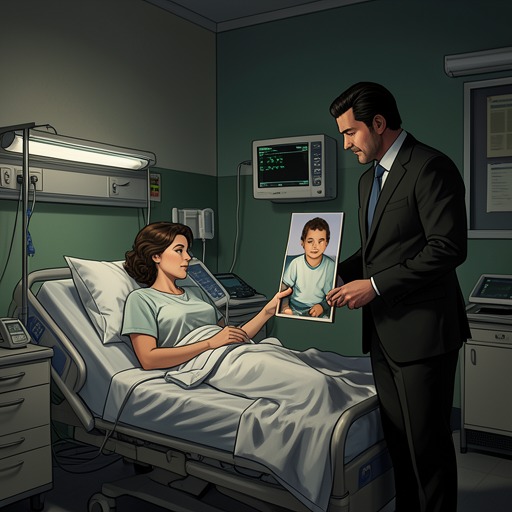
Susan Cartwright
The Birthday PartySusan Cartwright is an investigative reporter whose pursuit of Charlie Hamilton’s disappearance is driven by professional commitment and personal loss. She first approaches Kathy Hamilton at a cemetery, where her questions meet suspicion and refusal; later, her persistence earns her a place in Kathy and Megan Carter’s effort to find Charlie. Her investigation links the case to Olivia Jenkins’s disappearance and uncovers information about Megan’s biological family, making Susan a source not only of leads but of revelations that reshape the family’s understanding of itself.
Identity and Introduction
Susan identifies herself to Kathy as an investigative reporter concerned by the disappearance of little girls. She initially says she was at the birthday party, presenting herself as someone with firsthand context. When Kathy challenges this claim, Susan clarifies that she was not actually there: she is repeating what guests told her and wants Kathy’s perspective. The correction matters. Susan is willing to approach a grieving mother with an imperfect opening, but she does not continue to pretend she witnessed the party herself.
Kathy reacts warily. She has just lost her daughter from view and does not want to discuss Charlie with a stranger; once Susan identifies herself, Kathy walks away and tells her to stay away from the family. Susan does not force a conversation. She leaves a card under the windshield wipers of Mitch Hamilton’s car and says she is not from the tabloids, but is trying to understand what is happening in the town. Her appeal is investigative rather than purely sympathetic: she points out that Olivia has also been missing for eight months and urges Kathy to call when she is ready for help.
Reporting and the Search for Charlie
Susan’s warning that Charlie is not the only missing girl in town gives her approach a broader frame than the immediate search. Olivia’s disappearance had already been in the news, but Megan remembers that the media moved on quickly; in her account, Olivia’s mother struggled to keep the case visible while reporters lost interest in a family living in a trailer park. That contrast between Olivia’s disappearance and Charlie’s case raises the question of whether public attention and investigative resources will be shaped by the Hamiltons’ greater affluence and connections. Susan’s intervention connects the cases without asserting that they have the same perpetrator.
Kathy eventually finds Susan’s contact details and decides to call her without telling Chase Cooper or Mitch. She wants to undertake this step with Megan. When they meet Susan at a nearly empty coffee shop, her appearance is composed and professional: she wears a white shirt and black pants, with her long hair drawn back and glasses on. Megan is unsure whether Susan wants to help or is seeking an exclusive, and Susan treats that caution as sensible rather than insulting.
Susan says she works for the Vermont Daily News and has investigated missing-child cases since joining the paper. She describes helping to find a twelve-year-old boy alive in a town south of Maple Falls. She distinguishes that work from salacious gossip, even acknowledging that her editor would prefer a more sensational approach. She has also been liaising closely with Olivia Jenkins’s mother and believes Charlie’s disappearance may be connected to Olivia’s. She makes clear, however, that she would investigate Charlie’s case even if the two disappearances did not appear linked.
Susan also proposes sharing what she learns with Chase Cooper, rather than treating the police investigation as a rival to beat. She asks about Kathy and Mitch, the secrecy surrounding Megan’s motherhood of Charlie, and visitors to the Hamilton home, including Scott Bowers and Cindy Bowers. Her questions are probing: she tells Megan that she wants to examine the family’s private lives and notes that some alibis have not held up. This method can unsettle the people she is trying to help, but Susan presents openness as a way to assist both the family and the investigation.
Personal Loss and Motivation
When Kathy asks why the case is personal to her, Susan reveals that her sister’s son was abducted nine years earlier and has never been found. Her sister could not bear the uncertainty and died by suicide four years before the conversation. Susan describes herself as part of a family living with a missing child, and says she understands the disbelief and heartache experienced by Megan and the others.
This history gives Susan’s work an intimate stake without erasing its professional character. She does not claim that her own family’s experience proves what happened to Charlie, nor does she offer certainty that the cases are connected. Instead, her account explains why the ongoing absence matters to her and why she continues to investigate after public attention might otherwise move on. Her knowledge of the strain caused by not knowing also shapes the care with which she checks on Megan: after learning that Olivia’s body has been discovered, Susan calls to ask how Megan is holding up and whether she is alone.
Investigation and Revelations
Susan’s contact with Megan extends beyond the missing-child investigation. At the coffee shop, she asks about Megan’s relationship with the Hamiltons and whether they have asked her to conceal anything. Megan confirms that Kathy and Mitch asked her to keep secret that she was Charlie’s mother, describing the arrangement as an effort to benefit Charlie; she also says she does not believe either Hamilton had anything to do with Charlie’s disappearance. Susan follows up by asking about people who regularly visited their house, including the Bowerses.
Later, Susan tells Megan that Olivia’s mother has informed her of the discovery of Olivia’s body. She recognizes the weight of the news and checks that Megan has support nearby. When Megan admits that, alone, she might have used cocaine, Susan does not recoil or shame her. She acknowledges the temptation while telling Megan that drugs will not answer the crisis. She then says she has information Megan may not know and suggests discussing it privately.
That information concerns Megan’s closed adoption and biological family. During the coffee-shop meeting, Susan had asked about Megan’s biological relatives while Kathy was in the restroom. She subsequently finds the identity of one of Megan’s biological parents; she cannot find the father, who is absent from the birth certificate and from the adoption records. Megan asks Susan to verify her findings, then receives proof by email. When she finally tells Kathy that Susan has identified her birth mother, Kathy loses color and appears physically shaken. The scene makes the revelation’s force visible without reducing it to a mere investigative fact: Susan’s work has exposed a family connection that Megan and Kathy had not previously acknowledged.
Narrative Role and Significance
Susan’s role joins two kinds of searching: the public investigation into missing children and the private effort to understand hidden family histories. Her early approach is imperfect, and Kathy’s distrust is justified by Susan’s initial implication that she attended the party. Yet Susan corrects the record, leaves a way to contact her, and later earns a meeting by explaining her experience, methods, and intentions. The novel thus presents trust as something she must build through disclosure and follow-through, not something a press credential automatically grants.
Her presence also makes the unequal distribution of media attention part of the search’s stakes. Olivia’s case demonstrates how quickly coverage can fade, while Charlie’s family status may keep reporters and police attention fixed on the story. Susan is both inside that media environment and critical of its appetite for sensational material. By connecting Olivia’s disappearance to Charlie’s and by uncovering Megan’s birth-mother identity, she alters what the characters know without claiming authority over what they should conclude. Her investigation turns information into a difficult form of help: it can widen the search, but it can also force painful truths into the open.